Clone Graph
Problem statement
Given a reference of a node in a connected undirected graph.
Return a deep copy (clone) of the graph.
Each node in the graph contains a value (int) and a list (List[Node]) of its neighbors.
class Node { public int val; public List<Node> neighbors;}Test case format:
For simplicity, each node's value is the same as the node's index (1-indexed). For example, the first node with val == 1, the second node with val == 2, and so on. The graph is represented in the test case using an adjacency list.
An adjacency list is a collection of unordered lists used to represent a finite graph. Each list describes the set of neighbors of a node in the graph.
The given node will always be the first node with val = 1. You must return the copy of the given node as a reference to the cloned graph.
Example 1:
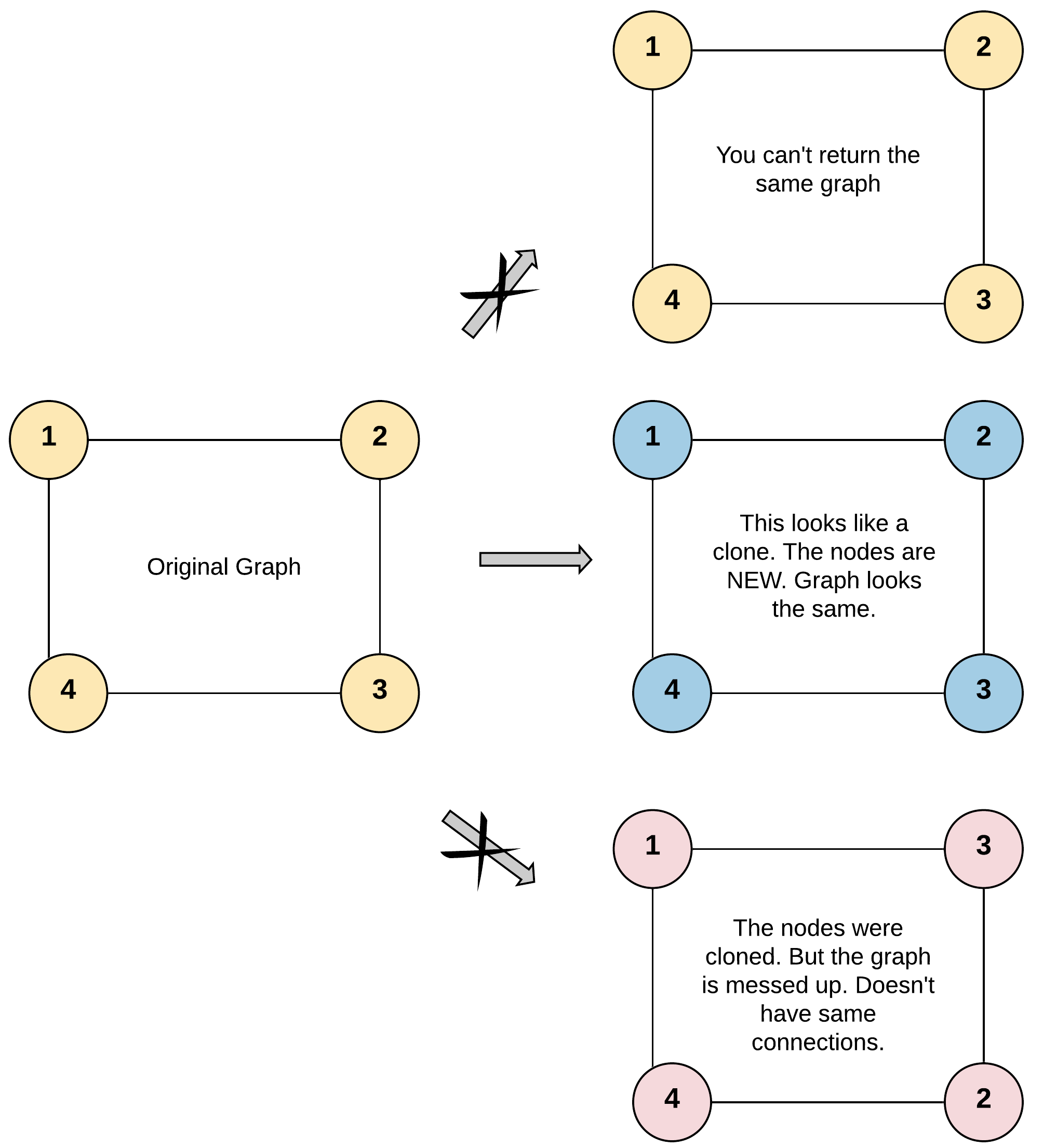
Input: adjList = [[2,4],[1,3],[2,4],[1,3]]Output: [[2,4],[1,3],[2,4],[1,3]]Explanation: There are 4 nodes in the graph.1st node (val = 1)'s neighbors are 2nd node (val = 2) and 4th node (val = 4).2nd node (val = 2)'s neighbors are 1st node (val = 1) and 3rd node (val = 3).3rd node (val = 3)'s neighbors are 2nd node (val = 2) and 4th node (val = 4).4th node (val = 4)'s neighbors are 1st node (val = 1) and 3rd node (val = 3).
Example 2:
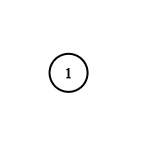
Input: adjList = [[]]Output: [[]]Explanation: Note that the input contains one empty list. The graph consists of only one node with val = 1 and it does not have any neighbors.
Example 3:
Input: adjList = []Output: []Explanation: This an empty graph, it does not have any nodes.
Constraints:
- The number of nodes in the graph is in the range
[0, 100]. 1 <= Node.val <= 100Node.valis unique for each node.- There are no repeated edges and no self-loops in the graph.
- The Graph is connected and all nodes can be visited starting from the given node.
My solution
/**
 * // Definition for a Node.
 * function Node(val, neighbors) {
 *    this.val = val === undefined ? 0 : val;
 *    this.neighbors = neighbors === undefined ? [] : neighbors;
 * };
 */

/**
 * @param {Node} node
 * @return {Node}
 */
var cloneGraph = function(node) {
    if (!node) {
        return node;
    }

    const arr = []
    dfs(node, arr)

    let nodeMap = new Map();
    for (let i = 0; i < arr.length; i++) {
        nodeMap.set(arr[i], new Node(arr[i].val))
    }

    for (let i = 0; i < arr.length; i++) {
        for (const neighbor of arr[i].neighbors) {
            let copiedNode = nodeMap.get(neighbor)
            nodeMap.get(arr[i]).neighbors.push(copiedNode)
        }
    }

    return nodeMap.get(node);
};

function dfs(node, arr, visited = new Map()) {
    if (visited.has(node)) {
        return;
    }

    visited.set(node, true)
    arr.push(node)
    for (const neighbor of node.neighbors) {
        dfs(neighbor, arr, visited)
    }
}