Path Sum
Problem statement
Given the root of a binary tree and an integer targetSum, return true if the tree has a root-to-leaf path such that adding up all the values along the path equals targetSum.
A leaf is a node with no children.
Example 1:
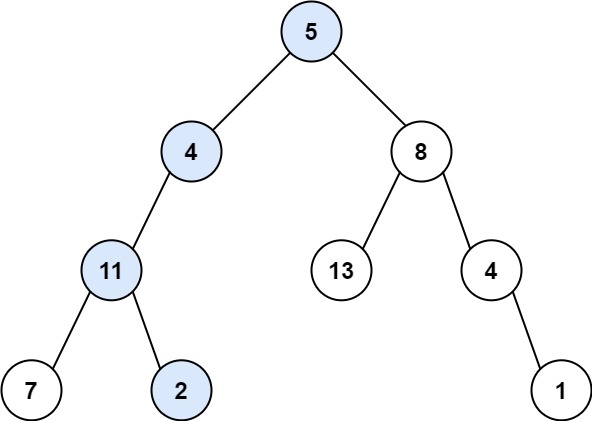
Input: root = [5,4,8,11,null,13,4,7,2,null,null,null,1], targetSum = 22Output: trueExplanation: The root-to-leaf path with the target sum is shown.
Example 2:
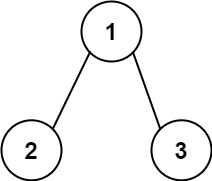
Input: root = [1,2,3], targetSum = 5Output: falseExplanation: There two root-to-leaf paths in the tree:(1 --> 2): The sum is 3.(1 --> 3): The sum is 4.There is no root-to-leaf path with sum = 5.
Example 3:
Input: root = [], targetSum = 0Output: falseExplanation: Since the tree is empty, there are no root-to-leaf paths.
Constraints:
- The number of nodes in the tree is in the range
[0, 5000]. -1000 <= Node.val <= 1000-1000 <= targetSum <= 1000
My solution
/**
 * Definition for a binary tree node.
 * function TreeNode(val, left, right) {
 *     this.val = (val===undefined ? 0 : val)
 *     this.left = (left===undefined ? null : left)
 *     this.right = (right===undefined ? null : right)
 * }
 */
/**
 * @param {TreeNode} root
 * @param {number} targetSum
 * @return {boolean}
 */
var hasPathSum = function(root, targetSum) {
    function traverse(node, remainingSum) {
        // console.log(node)
        if (!node) {
            return false;
        }

        if (!node.left && !node.right) {
            return node.val === remainingSum ? true : false
        }

        const localRemaining = remainingSum - node.val

        return traverse(node.left, localRemaining) || traverse(node.right, localRemaining)
    }

    return traverse(root, targetSum)
};