Minimum Height Trees
Problem statement
A tree is an undirected graph in which any two vertices are connected by exactly one path. In other words, any connected graph without simple cycles is a tree.
Given a tree of n nodes labelled from 0 to n - 1, and an array of n - 1 edges where edges[i] = [ai, bi] indicates that there is an undirected edge between the two nodes ai and bi in the tree, you can choose any node of the tree as the root. When you select a node x as the root, the result tree has height h. Among all possible rooted trees, those with minimum height (i.e. min(h)) are called minimum height trees (MHTs).
Return a list of all MHTs' root labels. You can return the answer in any order.
The height of a rooted tree is the number of edges on the longest downward path between the root and a leaf.
Example 1:
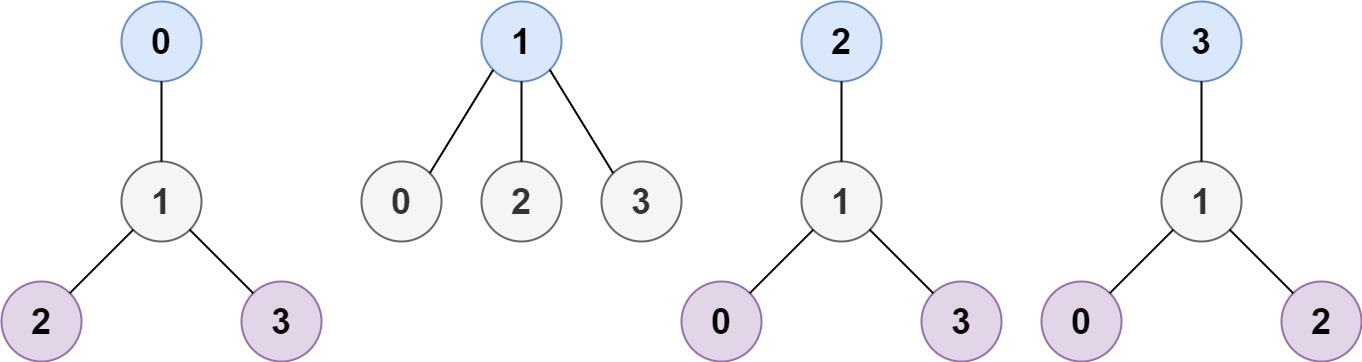
Input: n = 4, edges = [[1,0],[1,2],[1,3]]Output: [1]Explanation: As shown, the height of the tree is 1 when the root is the node with label 1 which is the only MHT.
Example 2:
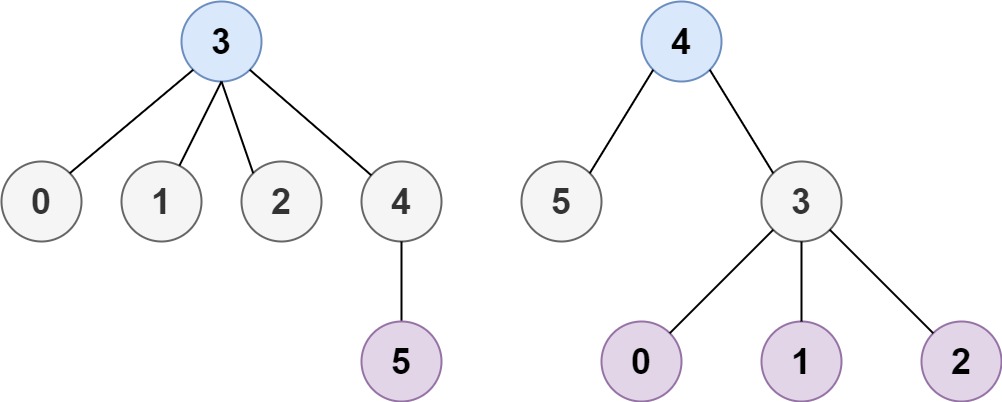
Input: n = 6, edges = [[3,0],[3,1],[3,2],[3,4],[5,4]]Output: [3,4]
Constraints:
1 <= n <= 2 * 104edges.length == n - 10 <= ai, bi < nai != bi- All the pairs
(ai, bi)are distinct. - The given input is guaranteed to be a tree and there will be no repeated edges.
My solution
/**
 * @param {number} n
 * @param {number[][]} edges
 * @return {number[]}
 */
var findMinHeightTrees = function(n, edges) {
    if (n === 1) {
        return [0]
    }

    if (n === 2) {
        return edges[0]
    }

    // Build the graph, Map<parent, <Set of leaves>>
    let roots = buildGraph(edges);

//     Build the queue with only the elements with 1 leaf
    const queue = []
    for (const [parent,leaf] of roots.entries()) {
        if (leaf.size === 1) {
            queue.push(parent);
        }
    }

//     Loop through until we have found the leaf and root
    while(queue.length !== roots.size) {
//         get the current length of the queue
        const currentQueueLength = queue.length;

        for (let i = 0; i < currentQueueLength; i++) {
//             Get the first leaf in the queue
            let leaf = queue.shift();
//             Get the parent of the left
            let leafParentValue = roots.get(leaf).keys().next().value
//             Get the parent node
            let parent = roots.get(leafParentValue)

//             Since we have already found leaf, remove from graph
            roots.delete(leaf);
//             Since we have already computed for leaf, remove from parent
            parent.delete(leaf);

//             If the parent has only 1 leaf left, add to queue
            if (parent.size === 1) {
                queue.push(leafParentValue)
            }
        }
    }

    return queue;
};

function buildGraph(edges) {
    let roots = new Map();

    for (let i = 0; i < edges.length; i++) {
        const [first, second] = edges[i]

        if (!roots.get(first)) {
            roots.set(first, new Set())
        }
        if (!roots.get(second)) {
            roots.set(second, new Set())
        }

        roots.get(first).add(second)
        roots.get(second).add(first)
    }
    return roots
}